ONE CUP · ONE PRICE
Unpacking a cup.
What makes up the price of coffee? How much reaches the people who grow it? We take one familiar cup apart as if it were a product—carefully, layer by layer.
GENERATED IMAGE · ILLUSTRATIVE
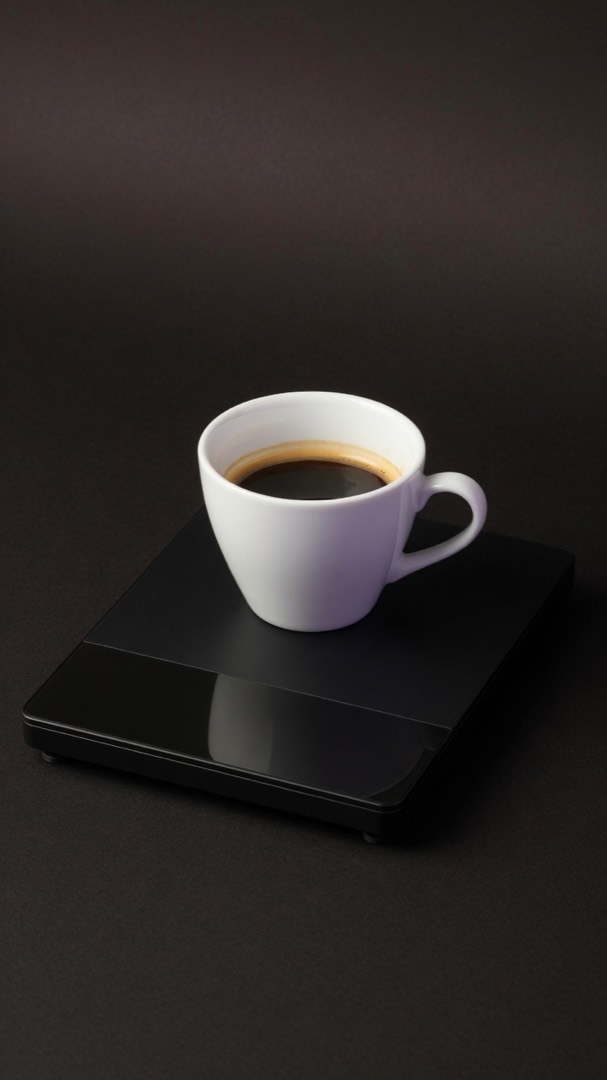
A white cup arrives across the morning counter. Most of what it holds is water. Yet its price carries a much longer journey: farms near the equator, ports and roasters, along with rent, equipment and human labour.
THE 30-SECOND READ
- In a typical filter brew, almost all of the finished drink is water. At the Golden Cup guideline ratio, 150 mL of brew water corresponds to about 8 g of coffee.
- A detailed 2021 study of German packaged household coffee found that cultivation, roasting, coffee tax and retail each accounted for roughly one fifth of retail value.
- That study is not a breakdown of a café drink, and it is not a current price sheet. The boundary matters as much as the number.
01 · MEASURE
A cup is mostly water.
Dissolved coffee makes up a little over one hundredth of the finished drink. The rest is water.
A filter-brew reference point. Espresso is different.
See how
A cup is mostly water.
IN ONE SECONDA small measure of coffee. The rest is water and time.
The Specialty Coffee Association of America’s Golden Cup Standard sets a filter-brew reference point of 55 g of coffee per litre of water, with a tolerance of ±10%, and a target brew-water temperature of about 93°C at the coffee bed.[1] Applied to 150 mL of brew water, that ratio corresponds to 8.25 g of coffee—about 8 g.
Not all of those 8 g dissolve. The standard’s preferred extraction range is 18–22%. Roughly one fifth of the ground coffee moves into the water; most remains in the filter. Dissolved coffee solids make up only 1.15–1.35% of the finished drink.[1]
This is a filter-brew standard. Espresso follows a different brewing logic.
02 · BREAKDOWN
Four layers carry similar weight.
Cultivation, roasting, retail and coffee tax: in one study of packaged coffee, each accounted for roughly one fifth of the retail price.
German household coffee in 2021—not a café cup.
See the layers
A price is made in layers.
IN ONE SECONDCultivation, transport, roasting, retail, tax. A single price is built across the chain.
First, an important boundary: this is not a breakdown of a café drink. The clearest example available here comes instead from packaged coffee sold for home consumption.
Across 41 coffee products sold by German retailers in 2021, the weighted-average retail price was €9.71/kg, including VAT and German coffee tax.[3] Retail, roasting, coffee tax and cultivation each represented 21–23% of that value. International transport plus collection and export at origin accounted for 6.8%; VAT accounted for 6.5%.[3]
Follow the layers
After costs and taxes, total profit across the chain was estimated at €1.09/kg—11% of the retail price.[3, p. 43]
For low-priced private-label ground coffee, the study estimated a retail-stage loss of €0.42/kg.[3, p. 32] National-brand capsules, by contrast, sold for €35.98/kg in the same modelling, illustrating how strongly format and branding can change the value structure.[3, pp. 35–36]
The study covers German household coffee in 2021, excluding instant coffee and foodservice. It does not directly describe the price of a café drink today.[3]
PASSPORT · THE STORY CONTINUES
Beyond the price swings
lies a global market.
The continuing edition follows global prices, climate and supply, demand, signals for the years ahead, and the effects on companies and cash flow.
- 03–04The price wave and a climate-shifting production map
- 05–07Global supply, demand regions and five signals to watch
- 08How higher prices flow through to companies and cash flow
FREE PREVIEW · SOURCES
Sources for the free edition.
- Specialty Coffee Association of America, “SCAA Golden Cup Standard” (revised 23 December 2015). View the original source
- BASIC (Bureau d’analyse sociétale d’intérêt collectif), author; Global Coffee Platform, IDH and Solidaridad, editors, “The Grounds for Sharing: A study of value distribution in the coffee industry” (2024; German data from 2021). View the original source
All photographs and backgrounds are digitally generated illustrations. This free preview ends after Chapter 02; later chapters are not included here.